
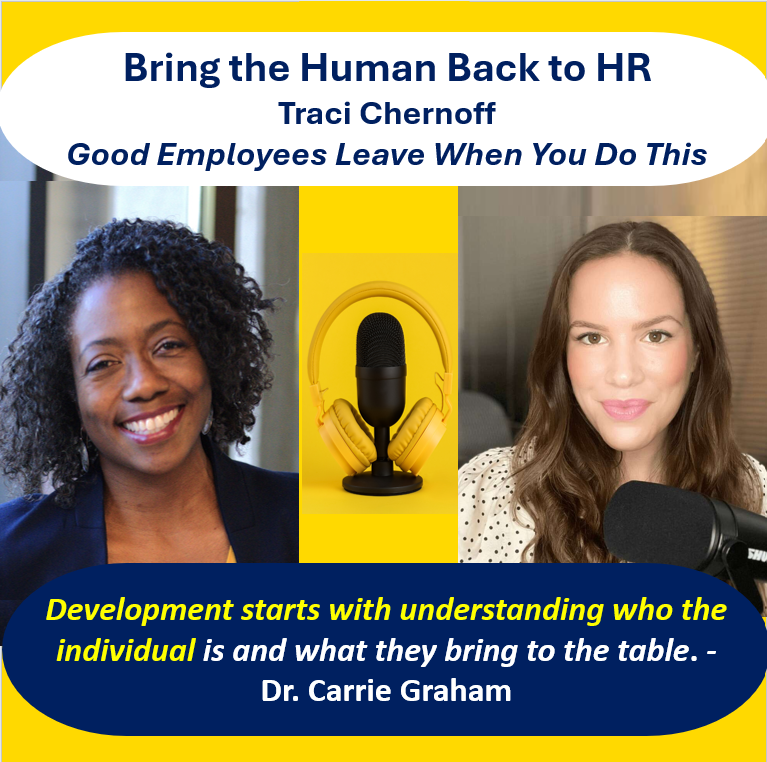
Listen Here >>> https://youtu.be/LjjFm9l80xQ?si=Vl5kYc1-EMYcb_JV
In this conversation with Traci Chernoff on Bringing the Human Back to Human Resources, we explored why people really leave one job for another, and what it takes to help them stay. The discussion centered on flipping the script from attrition to retention, on why good people leave bad managers who were never trained to lead, and on the difference between what an organization believes an employee brings to the table and what that employee is actually carrying. We covered dissertation research on high-functioning women in toxic work environments, the lasting health cost of unmet development promises, and why the social roles employees hold on day one rarely match the roles they're holding five or ten years later. At the heart of it all, a reminder that training and development is never just about retention numbers. It's about giving people the tools and the support to persist, to grow, and to stay.
1. Retention Starts With Flipping the ScriptMost organizations focus their energy on recruiting and rarely revisit what happens once someone is hired. Shifting the question from why do people leave to what can we do to support people who stay reframes training and development as a solve, not a symptom to manage.
2. Good People Leave Bad Managers Who Were Never Trained to ManageEmployees are routinely promoted into leadership because they have tenure, because someone else left, or because they simply asked. Without a professional development plan built around real leadership skills, that promotion sets both the manager and their team up to struggle.
3. Salary Isn't Always the Reason People StayEmployees will often stay at the same salary if an organization invests in their growth and mentorship. Skipping that investment doesn't just risk turnover. It also means a departing employee leaves without goodwill, instead of becoming a referral asset for future recruiting.
4. People Are Making the Culture, Not the CompanyIt's easy to attribute a toxic environment to abstract business decisions. In reality, individual leaders and managers are shaping, every day, whether an organization is a place people want to stay. That accountability can't be outsourced to org charts or AI.
5. A Single Client Story Shows What Understanding an Employee Really MeansA highly credentialed team member was struggling to advocate cross-functionally during a merger. It wasn't a skills gap. It was an unshared personal history that, once surfaced with the right support, transformed her confidence and performance in the room.
6. Development Has to Start With the Individual, Not the AssumptionWhat an organization believes an employee brings to the table is rarely the full picture. Real development requires taking the time to understand the nuances, the motivations, and the unspoken experiences that shape how someone shows up to do their job.
7. Dissertation Research Found a Real Cost to Broken Development PromisesResearch into high-functioning women in demanding work environments found that mentorship and career development were promised in recruiting but gatekept once employees arrived. Roughly 60 to 70 percent of those women experienced avoidable, life-changing mental and physical health effects as a result.
8. Employees' Social Roles Change, and Training Has to Change With ThemThe employee hired as a single, early-career professional is not the same person five, ten, or fifteen years later. Caregiving, parenthood, and shifting priorities evolve constantly, and organizations that don't account for that lose the people they worked hardest to keep.
9. Leader Frustration Often Signals a Missing Story, Not a Skills ProblemWhen a leader is frustrated by a team member's performance, the instinct is often to push harder. More often, there's a story underneath the behavior that, once understood, changes both the coaching approach and the outcome.
10. The Interview Process Works Both WaysProspective employees have every right to ask about culture, request time with a peer, or seek out someone who can speak honestly about what it's really like to work there. That transparency benefits the organization as much as the candidate.
1. Reframe Your Retention ConversationBefore your next hiring push, ask what you are doing to support the people already on your team. A recruiting strategy without a retention strategy is a leaky bucket.
2. Take the Free Training Assessment Quiz >>> here. Your score comes with a personalized report that shows exactly where your training and development infrastructure needs attention first.
3. Audit How You're Preparing New ManagersBefore promoting someone into a leadership role, confirm they have a professional development plan that builds real leadership qualities, not just tenure. Leading, mentoring, and developing others is a skill set, not an assumption.
4. Treat Mentorship as Retention InfrastructureIf salary increases aren't on the table, evaluate what meaningful development, mentorship, or growth opportunities you can offer instead. Employees who feel invested in refer others and speak well of your organization even after they leave.
5. Build in Time to Understand Your People, Not Just Manage ThemCreate space in one-on-ones or check-ins for employees to share context that might be shaping their performance. What looks like resistance or disengagement is sometimes an unshared story.
6. Revisit Your Onboarding and Recruiting PromisesIf your recruiting process promises mentorship and career development, confirm that promise is actually being delivered once someone joins. A gap between the pitch and the reality is where trust, and eventually employees, are lost.
7. Design Training and Development Around the Whole EmployeeBuild flexibility into your professional development plan that accounts for employees' evolving life circumstances, not just their job title or tenure. What worked for someone at hire may not fit who they are three years in.
8. Coach the Story Before You Coach the SkillWhen a team member is underperforming or resistant, ask what's happening for them before addressing what's happening in their work. Presentation coaching, feedback, and skill-building land differently once the real issue is understood.
9. Empower Employees to Ask Honest Questions in the Hiring ProcessEncourage prospective hires, and your own recruiting team, to normalize direct conversations about culture. Transparency upfront prevents costly, disengaged hires later.
10. Give Your Managers the Training They Were Never GivenIf your organization has promoted people into leadership without preparing them, that gap is fixable. Strategic training and development, built around real leadership skills, changes how those leaders show up for their teams.
Subscribe to get training and development insights that connect to real business outcomes—not just completion rates. Join here
Traci Chernoff is a Senior Director of Employee Engagement with ten years in critical HR leadership roles and the host of Bringing the Human Back to Human Resources. Traci explores the delicate balance between people and business and works to destigmatize what it means to work in Human Resources, bringing guests onto the show to unpack the real, human side of workplace decisions.
Website: hrtraci.com
LinkedIn: https://www.linkedin.com/in/hrtraci/
YouTube: https://www.youtube.com/@hrtraci
Get practical tools, strategies, and resources to design and deliver impactful training programs — right in your inbox.
.png)
Committed to provide research-informed, customized guidance to improve your training programs.
