Listen Here > https://youtu.be/YwJ51sJyaW4?si=lFSNpoX6fc9z6l4r
EPISODE SUMMARY
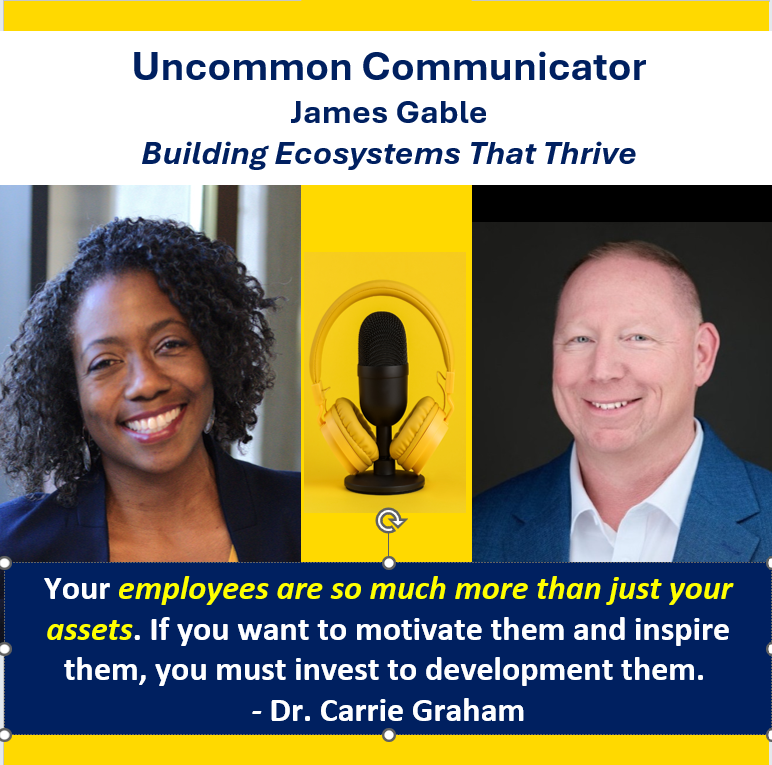
Dr. Carrie Graham joined James Gable to explore how organizations build sustainable learning ecosystems—places where training and development flow intentionally from the top down and knowledge moves freely across all levels.
The core problem: most organizations don't have learning ecosystems. Instead, they have isolated training events. HR runs a workshop. A new manager gets promoted and figures it out alone. Knowledge holders retire and take decades of expertise with them. This fragmented approach leaves critical gaps.
The episode opened with a fundamental distinction about adult learning that shapes ecosystem thinking. Adults don't learn in isolation; they learn by connecting new experiences to what they already know, emotionally anchoring that learning to their lives. This means your ecosystem must be designed around how adults actually learn—not how institutions traditionally teach.
Through a construction industry example, James illustrated what happens when you skip ecosystem building. You promote your best technical performer to foreman without developing their leadership qualities. You pair them with new employees who lack technical skills. You implement new systems without ongoing support. The result isn't just one person's failure—it's an ecosystem collapse. And this pattern repeats across every industry.
The conversation revealed that strong learning ecosystems require intentional knowledge transfer between experienced and emerging professionals. As one generation retires faster than the next can develop, organizations lose their institutional memory. Those that survive build systems—mentorship programs, documentation, recorded expertise—that capture and pass forward what seasoned professionals know. This isn't about promoting everyone; it's about creating pathways where knowledge flows systematically through the organization.
A critical insight: your ecosystem's culture is shaped by how you use every tool and resource. When leaders participate in training alongside employees, it signals learning belongs to everyone. When you mentor people different from yourself, you expand what's possible in your organization. When you admit mistakes and share learning moments (like Dr. Graham's reflection on using AI for content creation), you model the mindset that keeps the whole ecosystem growing.
The overarching principle: your employees are more than their job titles. When you build an ecosystem that treats them as whole humans with aspirations and growth potential—one where training and development flow from CEO to newest apprentice, where mentorship is intentional, where knowledge is preserved and transferred, where vulnerability and learning are valued—everyone thrives. The organization sustains excellence, leaders develop stronger teams, and employees feel truly invested in.
TEN KEY POINTS
- Your Learning Ecosystem Is Built on How Adults Actually Learn – Adults don't absorb knowledge like empty vessels. They learn by connecting new experiences to what they already know, anchored by emotion and relevance to their lives. Your ecosystem must be designed around this reality, not traditional classroom models. This means every piece—mentorship, training, knowledge transfer—must honor how adult brains actually work.
- Healthy Ecosystems Capture Learning From Everywhere – People learn through parenting, trades work, hobbies, and life experiences. Your ecosystem thrives when it creates pathways to transfer that learning into professional roles. Your best employees are learning constantly outside work; your job is helping them bring that growth back to the organization.
- Promotion Without Ecosystem Support Creates Cascade Failures – When you promote someone without intentional development systems, you don't just fail that person—you destabilize your entire ecosystem. The newly promoted leader struggles, their team disengages, talented people leave, and institutional knowledge walks out the door. Strong ecosystems have succession pathways built in.
- Your Ecosystem Requires CEO Participation to Function – Learning ecosystems don't work when leadership sits it out. When the CEO, founder, and executives actively participate in training and development, you send a signal that learning is fundamental to how your organization operates. Without leadership participation, you have scattered training events, not an ecosystem.
- Capacity Recognition Is Ecosystem Intelligence – Every person has capacity limits based on their current role and life stage. A healthy ecosystem recognizes when someone has mastered their role versus when they're overwhelmed by new responsibilities. This awareness guides where to invest development resources and how to structure growth pathways.
- Communication is Your Ecosystem's Circulatory System – Leadership communication skills aren't extras; they're foundational to how knowledge, direction, and culture flow through your entire ecosystem. Without them, your ecosystem has blockages. Leaders must develop these skills intentionally because they determine whether growth and learning actually reach everyone.
- Knowledge Transfer Infrastructure Determines Organizational Longevity – As experienced professionals retire, your ecosystem either captures their knowledge or loses it forever. Intentional mentorship, documentation, and systematic transfer create the institutional memory that keeps your ecosystem functioning through generational transitions. Without this infrastructure, you rebuild from scratch every five to ten years.
- Diversity in Mentorship Expands What Your Ecosystem Can Become – Leaders naturally mentor people like themselves, which narrows your ecosystem's potential. When you intentionally mentor people with different backgrounds, perspectives, and beliefs, you expand innovation, reach, and resilience. Homogeneous ecosystems stagnate; diverse ones thrive.
- Your Ecosystem's Culture Is Determined by How You Use Every Tool – Whether training is proactive (supporting growth) or reactive (punishing mistakes) shapes your entire culture. An ecosystem built on proactive development creates psychological safety and continuous improvement. One built on reactive training creates fear and fragmentation.
- Leader Vulnerability Strengthens the Entire Ecosystem – When leaders admit mistakes, share learning moments, and model the growth mindset you want to see, you normalize vulnerability across the whole ecosystem. This is how you move from a culture of hiding problems to one where people actively seek development and support each other's growth.
TEN TAKEAWAYS & ACTION ITEMS
- Audit Your Ecosystem Architecture – Map how learning currently flows (or doesn't) through your organization. Does it reach all levels or just frontline workers? Does leadership participate or observe? Does knowledge move between experienced and emerging professionals? The gaps you find are where your ecosystem is weakest and needs intentional redesign.
- Build Succession Pathways, Not Just Promotions – Before the next promotion, design what that person's development ecosystem looks like for their first year. What mentorship will they access? What peer learning will they participate in? What skills gaps will you close? Who will hold them accountable? This transforms promotion from an event to an ecosystem transition.
- Create a Knowledge Transfer Infrastructure – Identify your knowledge holders—the people whose expertise is critical to operations. Design systematic ways to capture and transfer their knowledge: mentoring relationships, recorded insights, documentation, rotation programs. This prevents ecosystem collapse when they leave.
- Map and Quantify Your Ecosystem's Weak Points – Calculate what it costs when communication breaks down, when knowledge gaps slow progress, or when talented people leave. Show the business impact of a fragmented ecosystem. Use this to justify ecosystem investments and keep leadership focused on the bigger picture.
- Design Intentional Mentorship Relationships – Stop mentorship by accident. Create formal structures where experienced professionals mentor people different from themselves—different backgrounds, perspectives, career paths. This builds ecosystem diversity and prevents the echo chamber effect.
- Get Your CEO Into the Ecosystem – If your CEO isn't actively participating in training, mentorship, and learning initiatives, your ecosystem will never fully function. Their absence signals that learning is optional. Their presence signals it's core to how you operate. Make CEO ecosystem participation non-negotiable.
- Shift From Reactive to Proactive Culture – Eliminate training-as-punishment language. Reposition training and development as proactive growth infrastructure. Talk about it in every meeting. Celebrate learning. Connect it to business outcomes. This cultural shift transforms how people experience your entire ecosystem.
- Assess Capacity and Design Role Transitions – When promoting someone or moving them into new responsibilities, assess their current capacity. Are they overextended? Have they mastered their role? Use this information to design a transition ecosystem that supports them through growth while maintaining performance. Don't just throw them into the deep end.
- Audit How You Use Tools and Communication – Every tool you use—AI, LMS platforms, social media—either strengthens or weakens authentic connection in your ecosystem. Before deploying anything, ask: Does this bring us closer together or create distance? Is this authentic to who we are? Tools should amplify your ecosystem, not replace it.
- Model Vulnerability and Learning From the Top – As a leader, publicly share what you're learning, mistakes you've made, and how you're developing. This sends the most powerful ecosystem signal: growth belongs to everyone, including leadership. When you normalize vulnerability, you give permission for the entire organization to embrace continuous development.
ABOUT THE HOST
James Gable is host of The Uncommon Communicator podcast, a space dedicated to helping leaders master the communication skills that transform organizations. With deep roots in the trades—including a four-year apprenticeship and years as a foreman—James brings practical, real-world perspective to conversations about leadership development and workforce challenges.
Currently working with co-build, James focuses on building organizational ecosystems where people thrive through intentional capacity-building, resilience development, and authentic connection. He's committed to breaking the generational cycle of knowledge hoarding by championing mentorship and knowledge transfer across the trades and construction industries, including his involvement with the Old Dogs Bunch—a group dedicated to capturing and passing forward industry expertise before it's lost.
James is a feedback advocate who believes training isn't about checking boxes; it's about retention, transformation, and helping people see what they're capable of becoming. He applies this philosophy to every conversation, every interaction, and every episode of The Uncommon Communicator.
Connect with James on LinkedIn or visit The Uncommon Communicator for more conversations on communication, leadership, and building cultures where people grow.
RESOURCE
Visit www.drcarriegraham.com to take the free Training Assessment Quiz and explore additional resources on organizational learning strategy.

.png)
