
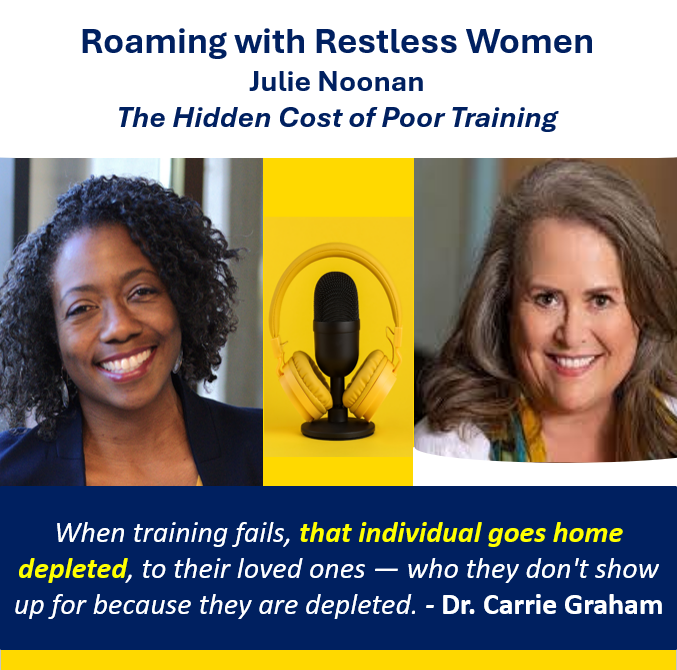
Listen Here > https://youtu.be/wrGljANoL5c?si=PlsPreCIIdwfKDfW
In this conversation with Julie Noonan on Roaming with Restless Women, we explored the connection between effective workplace learning and the real lives of the people doing the work. The discussion centered on how small and mid-size organizations often come looking for training when the deeper issue is organizational — and how leaders can learn to tell the difference. We covered what it looks like to build training programs that actually empower employees, why the leader is almost always the starting point, and how the decision to skip or underfund a professional development plan costs far more than the price of getting it right. The conversation also touched on navigating AI as a learning tool, the courage required to invest in people when it feels inconvenient, and what it means to lead with grace when you cannot see what your employees are carrying. At the heart of it all — a reminder that training and development is never just about completion rates. It is about people going home whole.
1. The Path to Consulting Was Paved in Sports MedicineA career that started in athletic training and university teaching shaped a unique lens for organizational work — one built on rapid assessment, listening beyond what is said, and identifying root cause before recommending any solution.
2. Organizations Come for Training. The Real Issue Is Usually Deeper.Small and mid-size businesses are drawn in by the promise of training and development — but more often than not, the presenting problem is a symptom of an organizational or leadership gap that no training alone can solve.
3. "I Need Teamwork Training" Is a Red FlagWhen a leader asks for teamwork training, it almost always signals a single person performance issue they have been avoiding — or a leadership and culture challenge that no team-building exercise will fix. The leader has to be part of the solution.
4. The Free Training Assessment Quiz Gives Leaders a Safe Starting PointTen questions. A score. A personalized report with next steps. The quiz was designed to let leaders be honest with themselves — privately — about where their training infrastructure and professional development plan actually stand.
5. A Low Score Is a Human Story, Not Just a Business ProblemWhen an organization scores in the 40s, what that number represents is employees going home depleted, disconnected from their families and communities, carrying the weight of an organization that has not invested in helping them grow or succeed.
6. Budgets That Say No to Training Are Saying Yes to Something ElseA real client — sole L&D professional across five locations, drowning in binders and digital folders — brought a compelling case. Leadership said there was no budget. That decision carries a price: turnover, burnout, and a workforce without the tools to do its best work.
7. Tools Do Not Fix SystemsPurchasing a new LMS before building a strategically designed training architecture is like buying a filing cabinet for a room with no floor plan. Technology is a tool. Without a system underneath it, it adds another layer of complexity instead of solving the problem.
8. Outdated Leadership Behaviors Cause Real DamageOrganizations that have not examined how their leadership skills, people practices, and management approaches have evolved are quietly eroding trust — and losing talent — without always knowing why. The work requires willingness to evolve, not just information.
9. The Why Behind the Work Is PersonalPeople spend more waking hours at work than anywhere else. When training fails them, they do not just underperform — they go home depleted and show up diminished for the people who need them most. That is the reason this work matters beyond any business case.
10. Restlessness Is Not a Problem to Solve. It Is an Invitation to Grow.The restlessness that comes when a path no longer serves you is not a malfunction. It is the signal that something better is asking to be built — whether that means getting off the path entirely, changing perspective, or inviting someone to walk it with you.
1. Diagnose Before You DesignBefore requesting or building any training program, ask whether you are solving a training problem or a leadership, culture, or systems problem. That one question determines whether the investment pays off.
2. Take the Free Training Assessment Quiz >>> here. Your score comes with a report that tells you exactly what to address first — and what kind of support will actually move the needle.
3. Start With the Leader, Not the TeamIf team performance is the concern, begin by examining the leader's role in shaping that team's culture, clarity, and capacity. Empower employees by first equipping the person setting the tone at the top.
4. Audit Your Existing Training ContentIf your training materials are scattered across binders, folders, and platforms, that is a structural problem. Inventory what you have before adding anything new. A strong professional development plan requires organized, accessible content as its foundation.
5. Think About Your Learner's Full LifeMid-career employees may be managing caregiving, career transitions, and competing priorities. Effective training and development accounts for who the learner is — not just what their job title says.
6. Build Leadership Skills That Include Learning StrategyAdd training and development literacy to your definition of strong leadership skills. Leaders who understand how adults learn and how to develop a professional development plan create measurably more resilient organizations.
7. Evaluate Tools Against Your System, Not Your ProblemsBefore investing in any new training technology, confirm that you have a clear, strategically designed learning system in place. A tool layered on a broken process amplifies the problem, not the solution.
8. Create a Feedback Loop in Your TrainingBuild at least one checkpoint into every training program where employees apply what they have learned and receive a response. This single addition — often missing from leader-designed training — is where development becomes real.
9. Lead With GraceYou will never fully know what an employee is managing outside of work. That awareness — held consistently — improves every training interaction, every development conversation, and every decision you make about how your team learns.
10. Take Your Own Restlessness SeriouslyIf something in your organization — or your own leadership — no longer feels like it is serving the people you are responsible for, pay attention. That discomfort is data. Address it before it becomes a pattern your team absorbs.
Subscribe to get training and development insights that connect to real business outcomes — not just completion rates. Join here
Julie Noonan is an International Coaching Federation accredited coach with more than 30 years of experience in executive coaching, leadership development, change management consulting, and organizational effectiveness. She is the founder of Intuitive Wisdom Coaching and the host of Roaming with Restless Women — a podcast dedicated to celebrating senior women leaders who are navigating transition, reinvention, and what comes next. Julie lives and works from her RV, traveling the country with her husband Tom and their dog Keyes.
Website: intuitivewisdomcoach.com
Podcast: intuitivewisdomcoach.com/roaming-with-restless-women-podcast
Be a Guest: podcast.intuitivewisdomcoach.com/podcast-guest
Email: julie@jnoonanconsulting.com
Get practical tools, strategies, and resources to design and deliver impactful training programs — right in your inbox.
.png)
Committed to provide research-informed, customized guidance to improve your training programs.
