
Listen here — https://www.youtube.com/watch?v=Y372-AQaNng&t
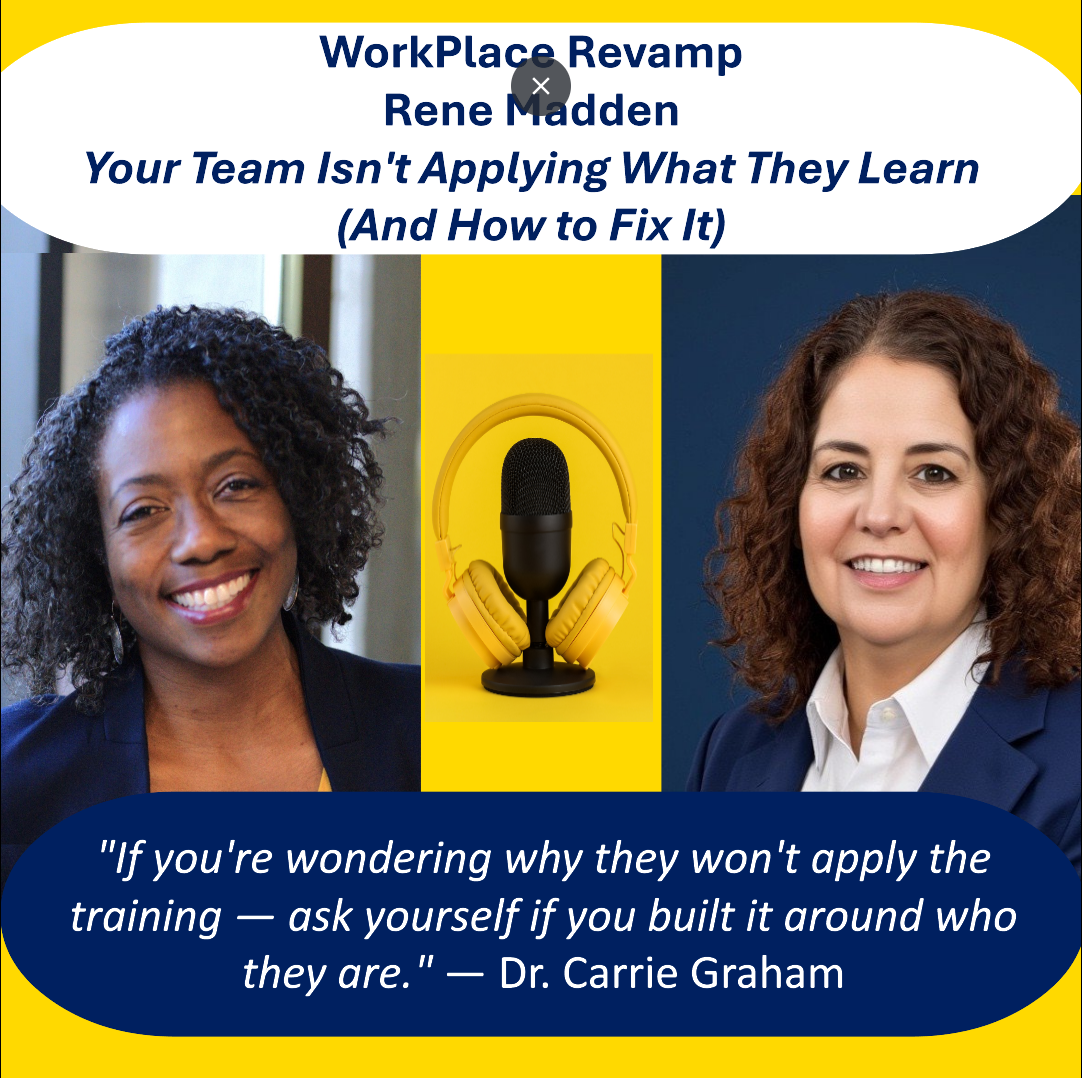
In this conversation on Workplace Revamp with host Rene Madden, we explored what it actually takes to build training that employees remember, apply, and carry with them long after the session ends. The discussion moved through the full arc of training development — from understanding why adult learners are fundamentally different from students, to the critical gaps organizations consistently miss between delivering training and expecting performance results. We talked about the real cost of ineffective training, why leaders have to be present in the room (and actually engaged), and how a clear purpose and honest gap analysis are the foundation everything else has to be built on. The conversation also surfaced a key principle that drives all of my work: training is never about the content or the trainer. It is always about the adult learners sitting at the table.
Training that doesn't engage adult learners or connect to their lived experience doesn't just waste time — it creates a barrier between your employees and the professional growth they're fully capable of achieving. A mid-career employee with years of insight is still being limited if the training never meets them where they are.
The executive function of the brain — responsible for judgment, decision-making, and critical thinking — doesn't fully develop until the mid-20s. Adults arrive at every training with rich life experience, past successes, past failures, self-perception, and internal motivation already in place. Training that ignores all of that is discounting a critical part of who your audience is.
Organizations frequently jump from "we need to train them" directly to hiring curriculum developers. The gap in between — understanding the real problem, the real purpose, and what already exists — is where most training programs start to unravel. Intention before production is not optional.
Before building anything new, look at what you already have. A genuine audit of your current training — what's working, what's missing, and what's misaligned — will tell you more than any outside consultant's template. The real problem and the perceived problem are often not the same thing.
Leaders under pressure want a fast fix. But training problems that took months or years to surface cannot be solved in a single session. Thought and intention are not luxuries in training design — they are the work itself.
Information-sharing and skill-building are two different things. Without structured opportunities to practice, receive feedback, and build confidence in a context that mirrors real conditions, employees leave the training room knowing more and doing nothing differently. That gap is a design failure, not a people problem.
Effective consulting and training strategy starts with understanding the organization's context from the inside — its culture, its wins, its tensions, its leadership climate. When I work with a team, the goal is never to get them to step into my framework. The goal is to step into theirs.
The most productive part of any organizational engagement is the conversation that nobody has had yet. Helping leaders feel safe enough to be honest — by normalizing their challenges through data and making space for silence — is how we finally put a finger on the real problem.
When a CEO, president, or executive director is not only present for a training but actively participating, it communicates to the entire organization that learning matters here. That signal is more powerful than any policy or mandate. And it also gives leaders firsthand experience of what good training actually feels and looks like.
The most important principle in all of training development: stop centering the content, the trainer, or the organization's agenda. Your employees are adult learners. They bring full lives, real experiences, and deep capacity to the training table. Build around who they are, and the results will follow.
Review your last training initiative. Did it account for what your employees already know and have experienced? If the content didn't make space for their perspective, plan a redesign that does — starting with a conversation with the people who sat through it.
Before your next professional development initiative, gather context on your team — their career stage, responsibilities, what motivates them, and where they feel stuck. Use that information to shape how the content is framed and sequenced. This is the foundation of adult learning-informed training design.
Write down — in one or two sentences — the specific outcome your training is designed to produce. If you can't articulate it clearly, pause. The design cannot be stronger than the purpose behind it. Leadership teams should be able to align on this before development begins.
Map what training your organization currently offers. Identify what employees are expected to know or do as a result of each program. Then compare that to actual performance outcomes. The gaps you find are your real development priorities — not the next trending topic.
When a performance issue surfaces and the instinct is to "just train them on it," slow down. Bring your leadership team together to ask: What is actually causing this? What do people already know? What is preventing them from applying it? Let those answers shape the response.
Identify at least one place in each of your current training programs where you can add a low-stakes practice activity before participants leave. Then add a follow-up touchpoint — one day out, three days out — where they apply a specific skill and receive feedback. Skills correction early prevents misinformation from becoming habit.
Build a structured check-in into your training timeline — not just a post-training survey, but a real conversation or application task with a response attached. Employees need to know their development is being tracked and supported, not just measured by attendance.
If your training programs have been running for two or more years without a meaningful review, schedule that conversation now. Pull in data, surface the tensions, and be willing to hear that the structure needs to change. The organization you're trying to build requires it.
Commit to being present — and genuinely engaged — in at least one employee training or professional development session this quarter. Not as an observer. As a participant. Notice what lands. Notice what doesn't. That experience will reshape how you invest in training going forward.
If you walked away from this episode wondering where your training programs actually stand, the Training Assessment Quiz is the right first step. It takes a few minutes, it's free, and the score-based report will give you a clear picture of where your training is working and where it's quietly costing you. Take it here.
Subscribe to get training and development insights that connect to real business outcomes — not just completion rates. Join here
Rene Madden is the host of Workplace Revamp, a podcast dedicated to exploring what really happens at work and how to make it better. Through candid conversations with workplace experts, Rene covers leadership, culture, and the practical strategies that help organizations move from chaos to clarity.
Get practical tools, strategies, and resources to design and deliver impactful training programs — right in your inbox.
.png)
Committed to provide research-informed, customized guidance to improve your training programs.
